Or, How to Swim Bravely When You’re in Way over Your Head
I had no business writing about Ludwig Mies van der Rohe. I did it anyway.
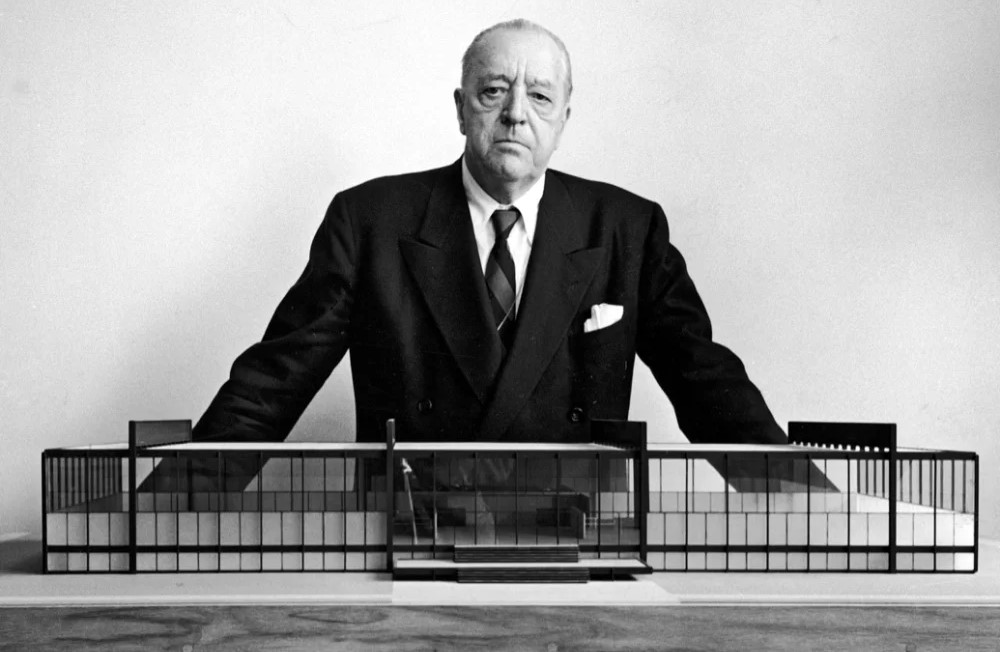
Ludwig Mies van der Rohe, architect. If you know him, you know.
He’s famous in the mythic-proportions sense—not just for his signature architecture characterized by clarity and simplicity, his exquisite use of materials, and his concept of universal space, but also for his disciplined, rational approach to architectural design. By the end of his life Mies was iconic enough that his work was reduced to a “style” and imitated. His status was of the sort that inevitably inspires detractors—he was rejected wholesale by postmodernists for two decades after his death. Ludwig Mies van der Rohe is also authentic enough to, in the decades since, be re-embraced and celebrated all over again as one of the most influential architects of the 20th century.
Even if you don’t know him, you know him. Maybe through the good fortune of encountering one of his buildings, whether intentionally or incidentally, in one of dozens of major cities in the United States and around the world. Or maybe by “Less is More” and “God is in the details,” the sayings for which he’s famous (even if he didn’t originate them).
Full disclosure: I didn’t set out to write a novel with Mies van der Rohe in it. My vision was to write about an architecture student in Nazi Germany. I stumbled across Mies’s name in my early research on the Bauhaus (“Ludwig Mies van der Rohe, director”); in the beginning, he was peripheral at best to the story I wanted to write. But as my research deepened and my novel evolved, the importance of Mies’s story to it became increasingly clear. And then I had a decision to make.
Incorporating a famous historical figure into fiction has its challenges (like needing to craft a character that lives up to everyone’s expectations). The ante is upped when the historical figure happens to be a pioneer in his field and also a genius. And if this weren’t daunting enough, with Mies van der Rohe there are certain unknowns regarding various decisions, artistic and otherwise, that he made in his lifetime, particularly during his time in Nazi Germany. How to handle these unknowns was what really gave me pause.
What followed was a lot of bargaining. I’ll touch on these years about his life and work, but not those. I’ll tackle these aspects of him but not those. I’ll confront these issues but run screaming from those. Different iterations of Mies emerged on the page: somewhat ethereal, limited in point of view, sometimes fuzzy on the big questions. Let him remain an enigma, I thought.
But a niggling concern would not let up: by not delving deep, was I cheating the reader? Cheating Mies? Cheating myself? Would I look back on my work and see a missed opportunity?
In his preface to Mies van der Rohe: A Critical Biography, Franz Schultze said that Mies, in addition to his many known attributes, “was capable also of self-doubt, confusion, and deviation from principle, of friendship and loyalty as well as their opposites, of actions, in short, that are perplexing and inconstant only if we presume he was as simple and fixed a character as his legend suggests.”
These nuances in character, these complexities: I realized that, as a reader, these are precisely what I would hope to see explored on the page—I wouldn’t want the writer to hold back out of deference or timidity or self-doubt. As a writer, I realized I needed to try. My timing was terrible: the manuscript, which I’d declared complete, was already out on submission to publishers. With apologies to my agent, I withdrew it and began a massive revision.
I found myself back at my desk, preparing to climb into the mind of Mies van der Rohe. If this sounds terrifying, well, it was. All the many ways I could get him wrong—it was nearly paralyzing. But I had to find a way to move past my fears and doubts.
How did I do this?
Obviously, the starting point was research. As far as Mies scholarship goes, there’s an embarrassment of riches. Books. Scholarly articles. YouTube videos. Blog posts. There’s almost too much. A million little rabbit holes to go down and get lost in. I had to be judicious. Of course he needed to be a well-rounded character. But I couldn’t—and shouldn’t—include every detail. The guiding question became, what serves the overarching story of which Mies is a part?
And it was this—the framework of the story, the safe confines of fiction—that ultimately liberated me to write about Mies. By treating him like a fictional character, by giving him a goal and a character arc, I gave myself permission to give him inner thoughts and opinions, to show him making the decisions that evolved along that arc. Obviously research remained a foundation for the things that captured his imagination and moved him to act, but it was the story that dictated which things and which actions to include. The story gave me the freedom and the courage to pick among the varying opinions of his biographers as to what motivated his choices. Whether or not they were the real motives (and there’s no way to know; even the most well-informed of his biographers can only speculate) is less important than whether or not these motives ring true.
Of course, coming to this realization made writing Mies possible; it didn’t make it easy. Let’s not forget that Mies was an architectural genius whose work was grounded in metaphysics. It’s important to mention that I am neither architect nor philosopher. Having the research didn’t mean I understood it. Fritz Neumeyer’s “The Artless Word,” the authoritative source on the evolution of Mies’s artistic philosophy from his own writings and the annotated books in his collection, read like a foreign language. And even once I felt like I maybe had a handle on the material, I had to write it in a way that was readable, comprehensible, and entertaining. The same goes for Mies’s work. I needed to understand and show an evolution of concepts, not just along the arc of his development as an artist, but in relation to the circumstances in which he was trying to work and according to the story as a whole. It’s not an exaggeration to say I was confronting my limitations on a daily basis. In the darkest hours of many nights I lay awake as the devil whispered in my ear about folly and failure. Who do you think you are, exactly? I had nightmares about drowning.
In the daylight hours, I just kept swimming. I even took the opportunity to further flesh out other historical figures in the manuscript, like Gunta Stölzl and Lilly Reich, and even to broaden my purely fictional characters. In the end, there wasn’t an inch of FAÇADE that wasn’t touched. (I sometimes wonder, had I truly known the blood, sweat, and tears this reworking would require, would I have done it?) Eventually, the revision that felt like it would never come to an end finally did. Off went the manuscript to the trusted Beta readers of my writers group. Then, after a few final tweaks, back to my very patient agent. And now, with the new version about to go on sub, I need to let it go, hoping I did Mies justice.
Meanwhile, new scholarly works, like these two and this one, continue to come out on Mies van der Rohe (a testament to his continuing relevance and how thoroughly his work and his person captivate people’s imaginations). I admit each new publication gives me a twinge. I feel on the one hand a little anxiety: what if this new book (or, honestly, any piece of research I might have missed) contains something I could have used to make Mies that much more accurate, accessible, real? I try not to think about it too much. And on the other hand, I feel a little stab of sadness. Letting go of the manuscript has in a sense meant letting go of Mies. We’d spent a lot of time together, Mies and I, and I’d grown more than a little fond.
 christine beth reish
2 thoughts on “How to Write a Genius: Mies van der Rohe in FAÇADE”