Or, Nobody Puts Influential 20th Century Designer Lilly Reich in the Corner
If you don’t know who Lilly Reich is, don’t feel bad. I nearly missed her, too. Not because her contributions to 20th century design and architecture were inconsequential; they weren’t. But for nearly a century, much of Lilly Reich’s work was downplayed, omitted, or attributed to someone else.
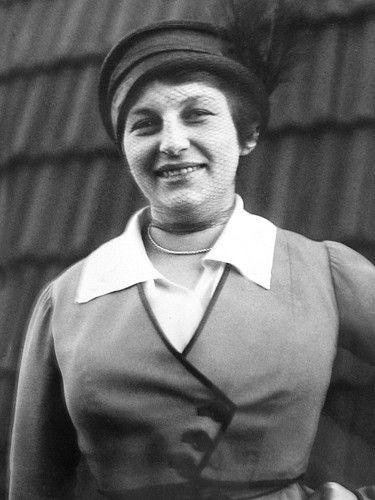
It’s a frustrating (but, perhaps, not all that shocking) story: the scope and significance of a brilliant and influential woman went misunderstood for decades, until long after her death.
Despite years of groundbreaking work prior to meeting and working with legendary architect Ludwig Mies van der Rohe, 20th century designer and architect Lilly Reich found herself cast in his shadow as someone secondary and peripheral, both to his work and to the world of architecture and design. And there she remained for over 50 years.
In the early decades of last century, Lilly Reich had made a name for herself in the art world with her solo work in interior design, fashion design, and exhibition design. By the time Mies van der Rohe sought her help with his first exhibition for the Deutscher Werkbund (a German association of artists, craftsmen, and industrialists), she’d already been involved with the Werkbund for over a decade and had been on its board of directors (a first for a female) for six years; she’d broken through numerous gender barriers, particularly the notion that women were less capable then men in the “greater” arts (Reich had succeeded in both the “lesser” and the “greater”). But once Mies came on the scene in 1926 and Reich embarked on what would be more than a decade of collaboration with him, it was abruptly assumed she’d settled for a subordinate role: that of his assistant.
According to a research article entitled, “Lilly Reich: The Architecture and Critique of an Invisibilized Woman,” right from the outset several of Reich’s individual contributions to collaborations were credited not to her, but to Mies, or at most to a joint effort. For example, in the 1929 International Exposition in Barcelona, for which Reich has since been acknowledged as having designed dozens of industrial design displays and contributed significantly to the design and furnishing of Mies’s famous Barcelona Pavilion, she went almost totally unrecognized. Referring to her as Mies’s “engster Mitarbeiterin” — his closest colleague/collaborator/assistant (literally his “female with-worker”) — the press ensured she would be thought of only in relation to Mies. That she was an artist with ideas of her own, that their collaboration might be a partnership in which each person brought something to the table, was never even put forth as a possibility.
Minimalized in the present, Reich’s real efforts were obscured from the future. The destruction of all her records in WWII when her Berlin studio was bombed didn’t help matters. Later, when historians began writing about Mies, they perpetuated the notion of Reich as artist-turned-assistant. Thanks to contemporary critics and then historians, Reich became, as the article claimed, invisibilized.
To invisibilize someone is to marginalize them or their contributions to the point that they’re erased. It may not come as such a surprise that a woman in the field of art in the 1930s (or, even, a woman in any field at any time) had been invisibilized. At that time even Bauhaus women, led to believe they would be treated equally to men, were given far fewer educational opportunities and were less well-known than their male counterparts, despite making significant contributions in their field.
While the image of Reich as strictly an assistant is a false one, a practice she engaged in during her time with Mies may have inadvertently supported the notion: outside of their design collaborations she, well, assisted him — with everything. Mies was famously disinterested in all things practical, and Reich voluntarily picked up his slack. In her book Architects of Fortune: Mies van der Rohe in the Third Reich, Elaine Hochman called Reich “his confidante, his business manager, the organizer of his life.” It may have been Mies who was the director of the Bauhaus, but it was Reich who saw to its administration. Beyond this, she answered Mies’s mail, saw that his bills got paid, ensured his estranged wife and daughters were cared for, and more.
One can’t help but to wonder, when Reich abounded with ability and creativity, with financial independence and a certain amount of agency, when she had her own studio to manage and some of her own commissions to concern herself with, why she bothered to devote so much of her time and energy to managing the details of Mies’s life. Perhaps she simply could not stand watching them go ignored. Perhaps she felt they were beneath a genius of Mies’s caliber. Perhaps she hoped to become indispensible to him. Or maybe it was something else. Biographers can only speculate what Reich’s motivations might have been. But as a fiction writer I had the freedom to decide why Lilly Reich does what she does.
The trick, though (and the rub for readers) is this: in my story Lilly Reich is not a point-of-view character. There is no peering inside her mind, and so she can only be made known by the things she says, the actions she takes, and the thoughts that my point-of-view characters— especially Mies — have about her.
And what did Mies think about Lilly Reich? There’s no record to tell us. He never said a word about their work—what it was like, what it involved, and certainly not who did what. He never stood up for her publicly or claimed she was anything more than his Mitarbeiterin. But in spite of Mies’s silence, in spite of what the press did and did not say, we know now that Lilly made significant contributions while collaborating with Mies. To me that’s suggestive of a kind of magic in their working relationship. The matter of how to convey this — and how to convey Mies’s true feelings when on the surface he seemed altogether indifferent to feelings — was just one of a myriad of ways I had my work cut out for me. But writing Mies-and-Lilly scenes were among the greatest joys I had in composing this story.
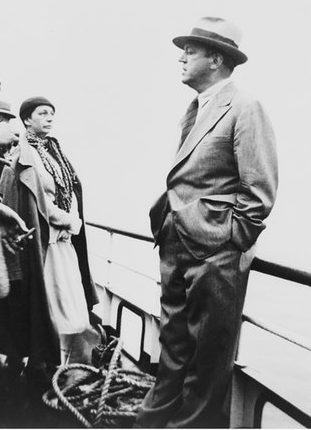
Apparently it wasn’t until the 1980s—over 30 years after Reich’s death—that historians finally started to seek, and to begin to uncover, evidence of the pioneering work Lilly Reich did during her time with Mies van der Rohe. Scholars and members of the world of art and design continue to endeavor to right Reich’s record. If you Google Lilly Reich today, you’ll come across numerous articles and posts that assert how impactful she was on the world of design and architecture (like in this great Core77 post). Significantly, in 2018 the Fundació Mies van der Rohe established the Lilly Reich Grant for Equality in Architecture in an effort to “support the study, dissemination and visibility of contributions in the field of architecture that have been unduly relegated or neglected for discriminatory reasons.” The inaugural award was granted for a work that highlights Lilly Reich’s role in the 1929 Barcelona Pavilion; the second was awarded to the authors of the aforementioned research article for their subsequent short film, “On Set with Lilly Reich.”
 christine beth reish
3 thoughts on “Who is Lilly Reich? If You Don’t Know, It Probably Isn’t Your Fault.”